Compass Academy Live Online
Filters
Ethics in the Digital Age is Part 2 of our Core Competencies Series on Ethics. For the full series, sign up for the entire workshop and receive a deep discount!
Artificial intelligence (AI) and social media are rapidly transforming the landscape of mental health practice. From AI-assisted documentation tools and chatbot-based interventions to clinicians’ professional presence on social media and emerging boundary challenges, these technologies introduce complex ethical considerations for practitioners.
Mental health professionals must navigate evolving technological standards while continuing to adhere to established professional ethical codes, including those of the American Counseling Association (ACA), American Mental Health Counselors Association (AMHCA), National Association of Social Workers (NASW), and American Psychological Association (APA).
This course equips clinicians at all stages of their careers with practical, ethically grounded decision-making tools for integrating AI technologies and managing social media presence in clinical practice. Participants will explore key ethical principles related to confidentiality, informed consent, documentation, professional boundaries, and digital professionalism. Through case examples and applied decision-making frameworks, clinicians will learn strategies to responsibly incorporate emerging technologies while safeguarding client welfare, confidentiality, and professional integrity.
By the end of this program, participants will be able to:
Identify key ethical principles that apply to AI use in clinical mental health practice.
Analyze confidentiality, informed consent, and documentation risks related to AI-assisted tools.
Evaluate ethical challenges related to clinicians’ social media presence and client interactions online.
Apply ethical decision-making models to technology-related dilemmas.
Develop risk-mitigation strategies for integrating AI and managing digital presence responsibly.
Join us to gain the practical skills and peace of mind necessary to navigate the complexities of modern mental health practice.
Credits: 3 NBCC approved CEU’s
Date: Friday, July 31, 2026
Time: 9 am-12:30 pm
Location: Online- Information will be emailed upon registration
Investment: Regular course price- $150
Early bird discount- $115 when you sign up before June 15
Discount will be automatically applied when you register- but only before June 15!
Please read our Course Agreement prior to registering for the course.
Upon purchase, you will receive a digital Welcome Packet containing your Google Meet link and session instructions. Please download this within 24 hours of purchase
Ethical Decision Making in Mental Health is Part 1 of a 2 Part Core Competencies Series on Ethics. For the full series, sign up for the entire workshop and receive a deep discount!
Ethical dilemmas are an inevitable part of clinical work, yet they often trigger significant anxiety and imposter syndrome for even the most seasoned therapists. This session is designed to move beyond the "fear of the board" and into a space of clinical confidence and clarity.
Led by Stacy Phillips, a clinician certified in DBT and clinical supervision, this workshop bridges the gap between complex legal mandates and day-to-day therapeutic practice. You won’t just study the rules; you will learn how to apply them.
What You’ll Gain:
A Clear Framework: Master the hierarchy of ethical decision-making to understand when legal mandates take precedence and how to prioritize competing values.
Evidence-Based Tools: Learn to apply clinically researched ethical models to real-world dilemmas, ensuring your practice is both safe and sound.
Hands-On Experience: Move past theory through interactive role-plays that simulate the high-pressure scenarios you face in the consulting room.
Clinical Confidence: Deconstruct the "imposter syndrome" often associated with ethics and walk away feeling empowered to make difficult decisions with professional integrity.
Transform your approach to ethics from a source of stress into a foundation of clinical excellence. ---
Join us to gain the practical skills and peace of mind necessary to navigate the complexities of modern mental health practice.
Credits: 3 NBCC approved CEU’s
Date: Friday, June 26
Time: 9 am-12:30 pm
Location: Online- Information will be emailed upon registration
Investment: Regular course price- $150
Early bird discount- $115 when you sign up before May 29
Discount will be automatically applied when you register- but only before June 12!
Please read our Course Agreement prior to registering for the course.
Upon purchase, you will receive a digital Welcome Packet containing your Google Meet link and session instructions. Please download this within 24 hours of purchase
This is a 2 part workshop made of our Sex Therapy Essentials Courses:
Sex Therapy 101 (Part 1)
Sex Therapy, Ethics, and Interventions (Part 2)
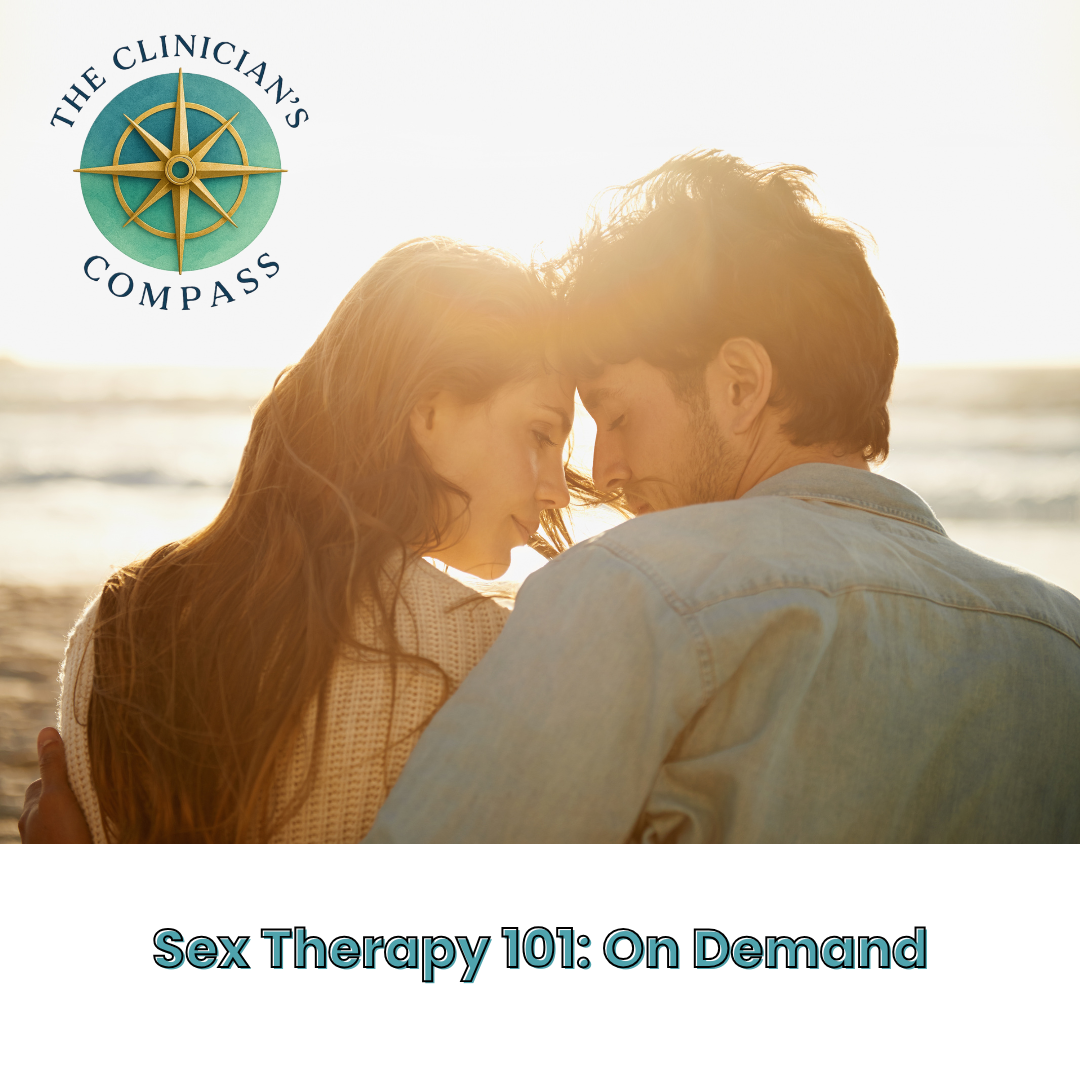
Sex Therapy 101 (Part 1)
Join Kristin, our AASECT-approved provider and educator, as she guides clinicians on a transformative journey into one of the most underdeveloped—and most essential—areas of clinical training: sex and sexuality.
Whether you work with individuals, couples, or clients across the lifespan, conversations about sex inevitably arise. This training is designed to help clinicians move beyond discomfort or avoidance and toward confidence, competence, and clarity. Participants will develop the skills to thoughtfully assess, discuss, and address sexual concerns in a way that is ethical, inclusive, and clinically grounded—supporting clients in one of the most intimate areas of their lives.
If sex shows up in your therapy room (and it does), you don’t have to feel unprepared. This experience empowers clinicians to meet these conversations with confidence and care.
By the end of this program, participants will be able to:
Identify common barriers clinicians experience when discussing sexual wellbeing with clients
Describe key sexual response models and their application to clinical work
Differentiate between spontaneous and responsive desire and assess for desire discrepancy
Utilize permission-based language to normalize sexual health concerns within therapeutic scope
Screen for common pelvic pain disorders and basic hormonal influences on sexual functioning
Apply the PLISSIT Model, BETTER Model, and Five-Domain Intake during sexual health assessments
Recognize when referral or interdisciplinary collaboration is clinically indicated
Sex Therapy: Ethics and Interventions (Part 2)
In the second part of our sex therapy series, we move from foundational knowledge to the nuances of clinical practice. This session bridges the gap between ethical responsibility and actionable change. We’ll begin by defining the scope of competence and the delicate power dynamics inherent in sexual health conversations. Attendees will learn to navigate complex boundaries and ensure informed consent remains at the forefront of every session.
Finally, we transition into the "what’s next," providing a roadmap for interventions, in-session techniques, and practical homework to help clients achieve their therapeutic goals.
By the end of this program, participants will be able to:
Analyze the Power Dynamics of Intimacy: Identify and evaluate the unique power imbalances and boundary nuances present when discussing sexual health within a clinical setting to maintain a safe, therapeutic environment.
Define Scope of Competence: Articulate the boundaries of their own clinical training regarding sexual dysfunction and apply specific criteria to determine when a referral to a specialist or medical provider is ethically required.
Facilitate Consent-Based Dialogue: Demonstrate the ability to integrate informed consent into clinical conversations about sexual history and behavior, ensuring client autonomy is preserved during sensitive disclosures.
Implement Evidence-Based Interventions: Select and apply at least three specific clinical interventions or techniques designed to address common sexual concerns during active therapy sessions.
Design Actionable "Sex-Positive" Homework: Develop structured, ethical take-home assignments for clients that bridge the gap between in-session processing and real-world behavioral change.
Credits: 9 NBCC and AASECT approved CEU’s
Dates: Friday, June 12 and Saturday, July 18
Time: 8 am-1 pm
Location: Online- Information will be emailed upon registration
Investment: Regular course price- $358
Early bird discount- $250 when you sign up before May 31st
Discount will be automatically applied when you register- but only before May 31st!
Please read our Course Agreement prior to registering for the course.
Upon purchase, you will receive a digital Welcome Packet containing your Google Meet link and session instructions. Please download this within 24 hours of purchase
This course is the first of our Sex Therapy Essentials Series for Clinicians.
Join Kristin, our AASECT-approved provider and educator, as she guides clinicians on a transformative journey into one of the most underdeveloped—and most essential—areas of clinical training: sex and sexuality.
Whether you work with individuals, couples, or clients across the lifespan, conversations about sex inevitably arise. This training is designed to help clinicians move beyond discomfort or avoidance and toward confidence, competence, and clarity. Participants will develop the skills to thoughtfully assess, discuss, and address sexual concerns in a way that is ethical, inclusive, and clinically grounded—supporting clients in one of the most intimate areas of their lives.
If sex shows up in your therapy room (and it does), you don’t have to feel unprepared. This experience empowers clinicians to meet these conversations with confidence and care.
By the end of this program, participants will be able to:
Identify common barriers clinicians experience when discussing sexual wellbeing with clients
Describe key sexual response models and their application to clinical work
Differentiate between spontaneous and responsive desire and assess for desire discrepancy
Utilize permission-based language to normalize sexual health concerns within therapeutic scope
Screen for common pelvic pain disorders and basic hormonal influences on sexual functioning
Apply the PLISSIT Model, BETTER Model, and Five-Domain Intake during sexual health assessments
Recognize when referral or interdisciplinary collaboration is clinically indicated
Credits: 4.5 NBCC and AASECT approved CEU’s
Date: Friday, June 12
Time: 8 am-1 pm
Location: Online- Information will be emailed upon registration
Investment: Regular course price- $179
Early bird discount- $150 when you sign up before May 29
Discount will be automatically applied when you register- but only before May 29th!
Please read our Course Agreement prior to registering for the course.
Upon purchase, you will receive a digital Welcome Packet containing your Google Meet link and session instructions. Please download this within 24 hours of purchase
This course is the second of our Sex Therapy Essentials Series for Clinicians.
Join Kristin, our AASECT-approved provider and educator, as she guides clinicians on a transformative journey into one of the most underdeveloped—and most essential—areas of clinical training: sex and sexuality.
In the second installment of our sex therapy series, we move from foundational knowledge to the nuances of clinical practice. This session bridges the gap between ethical responsibility and actionable change. We’ll begin by defining the scope of competence and the delicate power dynamics inherent in sexual health conversations. Attendees will learn to navigate complex boundaries and ensure informed consent remains at the forefront of every session.
Finally, we transition into the "what’s next," providing a roadmap for interventions, in-session techniques, and practical homework to help clients achieve their therapeutic goals.
By the end of this program, participants will be able to:
Analyze the Power Dynamics of Intimacy: Identify and evaluate the unique power imbalances and boundary nuances present when discussing sexual health within a clinical setting to maintain a safe, therapeutic environment.
Define Scope of Competence: Articulate the boundaries of their own clinical training regarding sexual dysfunction and apply specific criteria to determine when a referral to a specialist or medical provider is ethically required.
Facilitate Consent-Based Dialogue: Demonstrate the ability to integrate informed consent into clinical conversations about sexual history and behavior, ensuring client autonomy is preserved during sensitive disclosures.
Implement Evidence-Based Interventions: Select and apply at least three specific clinical interventions or techniques designed to address common sexual concerns during active therapy sessions.
Design Actionable "Sex-Positive" Homework: Develop structured, ethical take-home assignments for clients that bridge the gap between in-session processing and real-world behavioral change.
Credits: 4.5 NBCC and AASECT approved CEU’s
Date: Saturday, July 18
Time: 8 am-1 pm
Location: Online- Information will be emailed upon registration
Investment: Regular course price- $179
Early bird discount- $150 when you sign up before June 26
Discount will be automatically applied when you register- but only before May 29th!
Please read our Course Agreement prior to registering for the course.
Upon purchase, you will receive a digital Welcome Packet containing your Google Meet link and session instructions. Please download this within 24 hours of purchase
No results found
No results match your search. Try removing a few filters.